
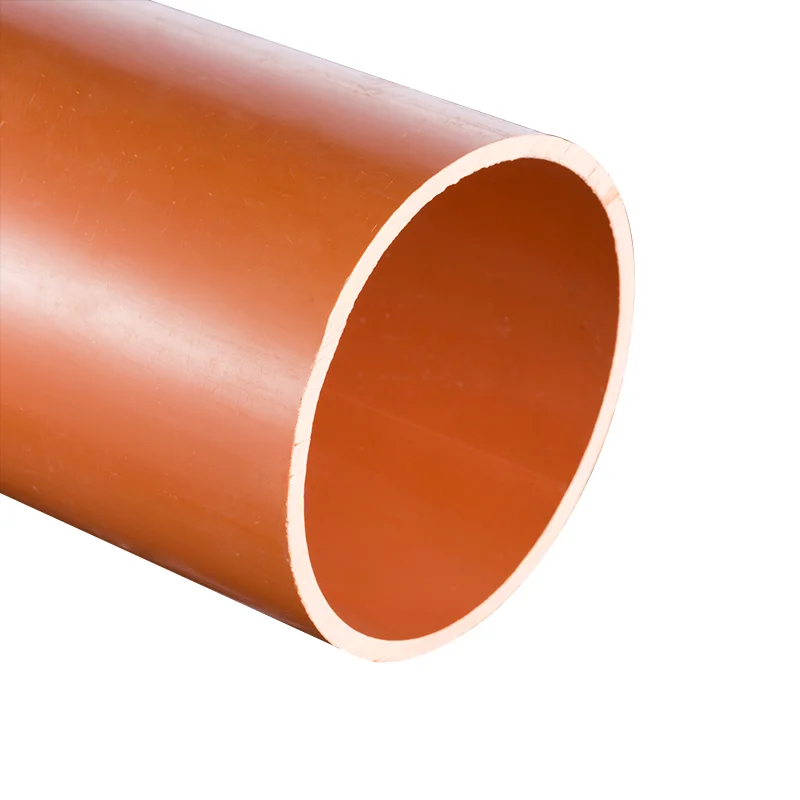
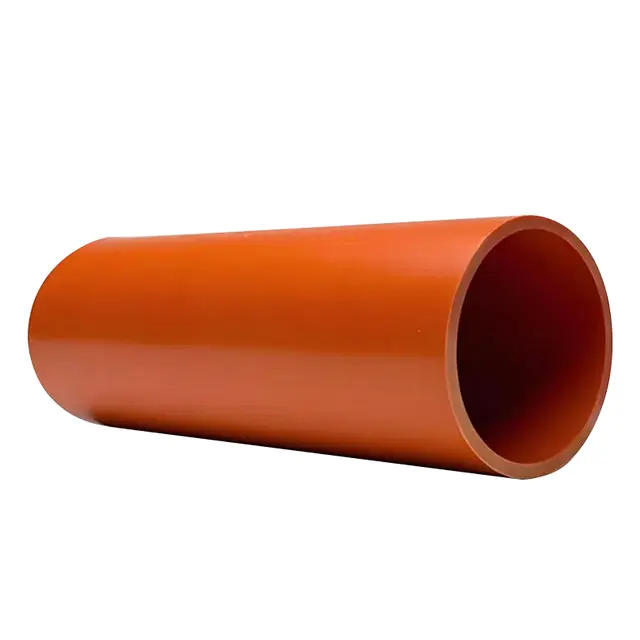
Municipal engineering hard buried threading CPVC high voltage power pipe wire and cable…
CPVC conduit for buried power-cable protection projects.
Product reference: pd556625748
Information to confirm before ordering
Product availability, minimum order quantity, lead time, packing and commercial terms vary by model and order. The sales team will confirm them against your written requirement.
- Outside diameter and wall thickness
- Pressure class or ring-stiffness requirement
- Material grade and applicable standard
- Medium, application and installation method
- Quantity, packing and destination port
- Required delivery date and project documents
Product Description
The information below is based on the original product material. Available dimensions, performance grades and applicable standards can vary by model and project. Request the current datasheet and confirm the final specification before ordering.
1. Product Overview
PVC-C power cable protection tube: PVC-C resin is used as masterbatch, and anti-impact agent, stabilizer and other auxiliary materials are added through high-speed extrusion. The product has high strength, good flexibility, high temperature resistance, corrosion resistance,
It has the characteristics of flame retardant, good insulation performance, no pollution, not easy to age, light weight and convenient construction. The product performance is much better than traditional asbestos cable pipes and ordinary PVC-U pipes, and is an ideal substitute for traditional power cable sheathing pipes.
It can be widely used in underground cable protection pipes in urban and rural power cable construction, traffic roads and bridges, and industrial park cable projects. It implements the light industry industry standard of the People's Republic of China: QB/T2479-2005 standard.
2. Core advantages
Outstanding high temperature resistance
- The long-term use temperature can reach 90°C, and the short-term temperature resistance can reach 110°C, which is far higher than ordinary PVC-U pipes (60°C). It is suitable for high-temperature laying environments (such as power plants, steel plants, tunnels, etc.).
High strength & compression resistance
- Ring stiffness ≥10kN/m² (higher grades can be customized), strong impact resistance, ground load and mechanical pressure resistance, suitable for direct burial, pipe jacking and other construction methods.
Excellent corrosion resistance
- Resistant to acid, alkali, salt spray, oil pollution and chemical solvent corrosion, suitable for highly corrosive environments such as chemical industry parks, coastal areas, and sewage treatment plants.
Flame retardant and fire safe
- Comply with GB/T 14823.2 standard, flame retardant grade V-0, self-extinguishing when removed from fire, low smoke and non-toxic, reducing fire risk.
Convenient construction
- Light weight (about 1/5 of steel pipe), can be sawed, hot-melt welded or socket connected, with high installation efficiency and reduced overall cost.
3. Application scenarios
- High temperature environment: cable laying in power plants, steel plants, and boiler rooms
- Harsh corrosive environments: chemical industry parks, coastal areas, underground comprehensive pipeline corridors
- Places with high safety requirements: subways, tunnels, airports, data centers
- Fire power system: emergency lighting, fire pump room distribution line protection
4. Installation standards
1. Pipe pretreatment
- Cutting specifications: The vertical deviation of the incision is ≤ 2°. Large-diameter pipes (DN ≥ 110mm) require a guide rail cutting machine to ensure smoothness.
- Connection process: The depth of the socket reaches the 2/3 mark line of the socket. After gluing, rotate and insert within 30 seconds and maintain pressure for 30-60 seconds (depending on the pipe diameter adjustment).
2. Trench construction
- Foundation reinforcement: After the trench bottom is leveled, a 150mm cement mortar layer is laid. For soft ground, 100mm plain concrete needs to be poured.
- Burial depth requirements: ≥700mm for general areas, ≥1000mm for motor vehicle lanes/crossing sections, and 200–300mm operating space reserved on both sides.
3. Pipe fixing
- A standard 6-meter pipe is equipped with 3 pairs of pipe pillows, the distance between the pipe pillows is 2.0m, and the distance between the pipe pillows at the joint and the socket is 0.5m.
- When laying on the wall, the distance between pipe clamps should be ≤1.5m, and anti-detachment buckles should be installed at the corners.
4. Backfilling and testing
- Backfill material: Artificial layered backfill of soft soil with a density of ≥95%. Mechanical backfill or inclusion of stones is prohibited.
- Pressure test: The water pressure is 1.5 times the working pressure and the pressure is maintained for 1 hour. If the pressure drop is ≤0.05MPa, it is qualified (gas pressure test is strictly prohibited).
5. Maintenance requirements
1. Daily inspection
- Surface condition: daily visual inspection without powdering/cracking, real-time temperature monitoring ≤90℃ (alarm threshold 120℃).
- Connection points: Use a torque wrench to check the bolt tightening force ≥15N·m every week.
2. Periodic maintenance
- Annual project: 5% citric acid solution circulation cleaning for 2 hours, ultrasonic wall thickness measurement (thinning amount ≤ 10% is safe).
- Quarterly project: valves are injected with food-grade silicone grease, and ground resistance detection is <10Ω.
3. Emergency treatment
- Leakage <3mm: Wrap with temperature-resistant leak-proof tape + stainless steel clamp to fix.
- Pipe burst accident: stop immediately → isolate and alert → replace special repair casing.
Related Products
 ● Video
Fire communication underground CPVC traction high voltage power cable optical cable…
 ● Video
CPVC various specifications power pipe PVC-C buried power threading cable protection sleeve
 ● Video
CPVC plastic power pipe underground project power grid reconstruction high voltage cable…
 ● Video